If you think of learning in terms of a “journey”, let’s say, like climbing up a mountain. Some very natural questions to ask yourself before you embark on your journey are:
How high is the mountain
Do I need any specialist equipment or training
How long will it take me to get to the top
Do I need to climb with someone else for safety reasons
Am I physically and mentally capable of climbing up the mountain
You could of course, not ask yourself any of these questions, and so you would be highly likely to fail in your goal. It is not impossible to achieve the goal, but you would imagine it would be not without an element of personal danger and risk.
And when you consider the journey of learning to drive, here is a list of the topics that you will cover:
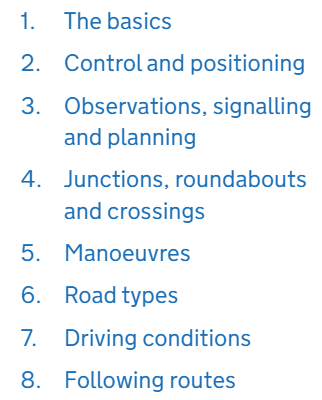
Don’t be fooled by the short list of 8 topics. Each one of these breaks down into smaller bite size subjects. There is a DVSA book on the subject of what you need to learn, it is called “Driving the Essential Skills” and you can buy it from www.safedrivingforlife.org for £19.99
It is a comprehensive book with hundreds of pages, beautiful graphics, and very handy tips and techniques. The advice is the best advice that you can buy, rest assured that anything you learn from that book is directly aligned to how the driving examiner will be assessing you when you take your driving test.
If you don’t want to go buy that book, but you are interested in knowing what is contained in those 8 items above, then a good place to see the 27 skills that you need to learn is by clicking on this link
So, where have you got to so far on this blog? Well done for taking the trouble to read the blog, but have you gone off and ordered that wonderful DVSA book for £19.99? Did you instead, click on the link above and see the 27 skills? Did you neither?
You see, how you get on in this journey of learning how to drive is going to depend on many things, and one of them will be your attitude to learning. Do you know how you like to learn? Do you know if you will struggle with any aspects of driving such as: speed or having a lorry behind your car or perhaps multi-tasking, maybe reversing?
It might prove a good use of your time to think about this. Using the climbing up a mountain example, might it not be worthwhile to understand before you leave if you suffer with heights, whether you struggle to learn knots, whether your fitness levels are adequate for the task?
The temptation will be to assume that everything is going to work out just fine, in fact, many people assume that learning to drive must be easy because they have a brother, sister or friend who passed the driving test, so therefore, they assume, it must be easy. In fact, the ease with which one learns to drive is highly personal and unique, it depends on a multitude of factors. Some of the factors that affect you, may not have affected your brother, or sister or friend. Likewise, they may have had to deal with obstacles to learning that are unique to them.
In a similar way, parents might be of the view that in their experience, learning to drive was easy so therefore it must be easy for their son or daughter too. As such, any conversation on the subject of learning to drive is heavily biased in mockery or veiled insults where the parent openly says how surprised they are if their son or daughter is struggling with anything.
Sometimes, if a parent struggled with a particular aspect of learning to drive, for example parking, they remember this clearly and they transfer that fear over to their son/daughter because they assume that it may well affect them too.
And the other thing to consider when you learn to drive is that ultimately, you are wanting to be able to drive unsupervised. Now this is where the climbing analogy is lacking because you may well be taking a friend with you on the climb who has a lot of experience and talks you through what you need to do – so you simply do what they say.
We do a similar thing to this when learning to drive. It is called, “Level 1 – full talk through”. It is the first of these five levels shown below:
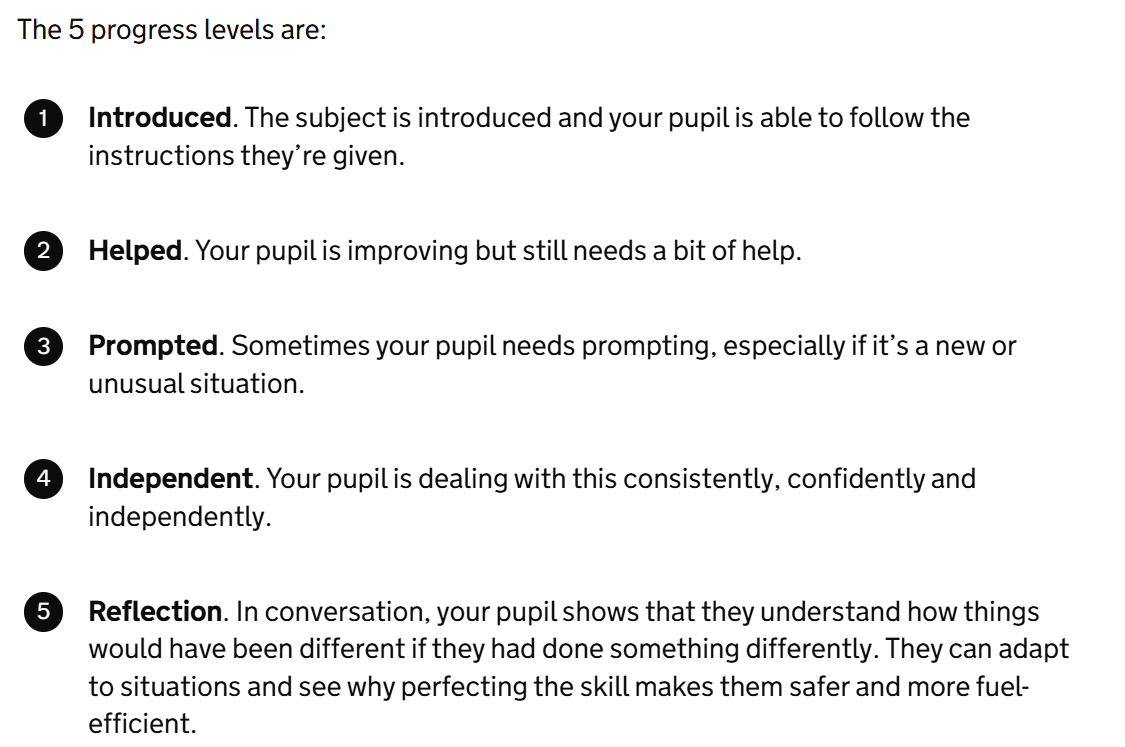
Being at level 1 is actually a very nice place to be – as you would hope it is when you start. You simply listen carefully to your driving instructor and they talk you through everything. No second guessing needed, no risky decisions to make, no compromising on safety, no stress put on you for knowing what to do. And there is an important point to recognise from these five levels. When you are practising a topic like driving on dual-carriageways, initially, you just do as you are told – level 1. Happy days. But as you continue to practise on them, you would be noticing that with no adverse effects on the outcomes, your driving instructor begins to say less and less, until eventually, after some time, you notice they are not needing to say anything to you. So the important point here is that it is not just the 27 skills that you are trying to learn, but it is being able to execute the 27 skills….unaided. That is the ultimate goal. Consider this conversation for a moment:
Driving instructor: Just remind me, have you done dual-carriageways before John?
John (pupil): Yes, they are all done.
Driving instructor: Ok, good. So just talk me through what you have done on them?
John: What do you mean?
Driving instructor: The practice that you have done on them, what did it involve?
John: Oh right. Well, do you remember a few weeks ago, when I drove to [name of town], there was a bit of dual-carriageway that I drove on.
So we can see from this conversation that John has definitely not been made aware of all the sub-topics involved in driving on dual-carriageways. John drove a short distance on a dual-carriageway, on one lesson, and thinks that topic is “done”. Here is what he actually needs to learn:
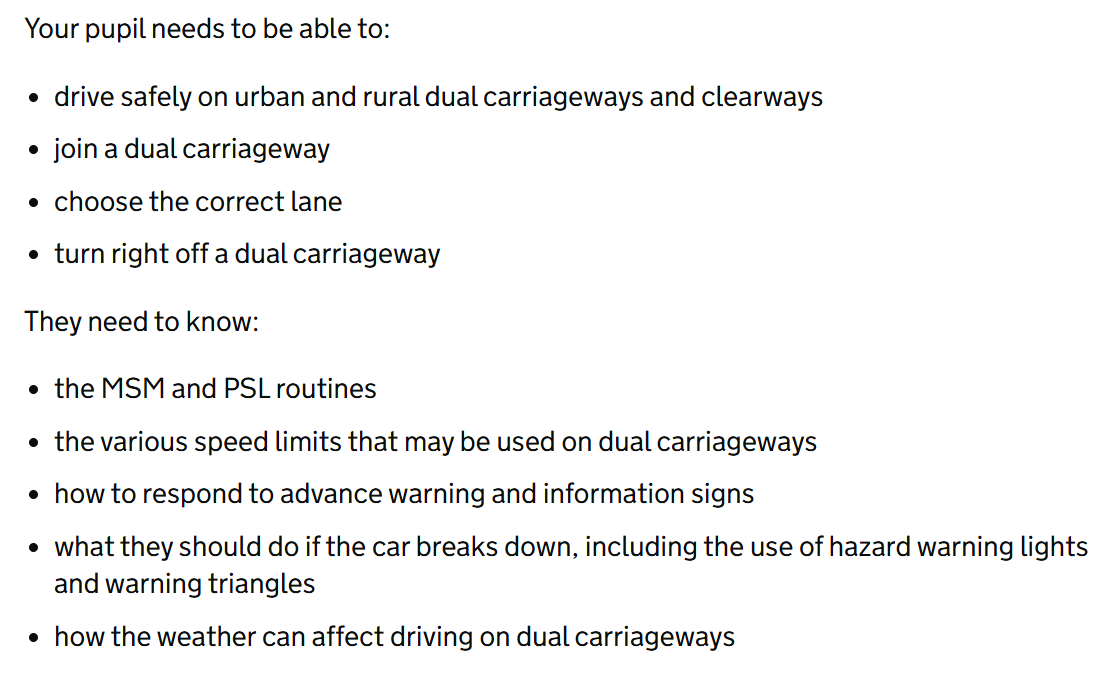
John’s experience so far, as beneficial as it undoubtedly was, did not involve using a slip road to get on the dual carriageway for example. John got on the dual carriageway via an exit of a roundabout. So John is thinking dual carriageways are “done” and they are far from done. His instructor needs to talk him through using slip roads first, and then with continued practice, John should eventually be able to do that independently.
It is because of this attitude to learning, that pupils like John get disappointed when they fail driving tests. They haven’t taken the trouble to see what they need to learn, or made sure they can consistently do the skills unaided.
Now it is quite common for a pupil to decide to not want to get involved in tracking what they have done on the syllabus, or what level they are at, with the five levels of progress, and that is of course fine. But what that pupil should not then expect is to be able to decide when they should be going to take the test. They aren’t able to do that, because they haven’t been tracking their progress. So, if you pass over the responsibility of tracking progress to your instructor, you also hand over responsibility for knowing when you are safe to take the driving test.